
The Everyday Entrepreneur
Why Answering Services Are Losing Their Market in Oklahoma — What's Replacing Them
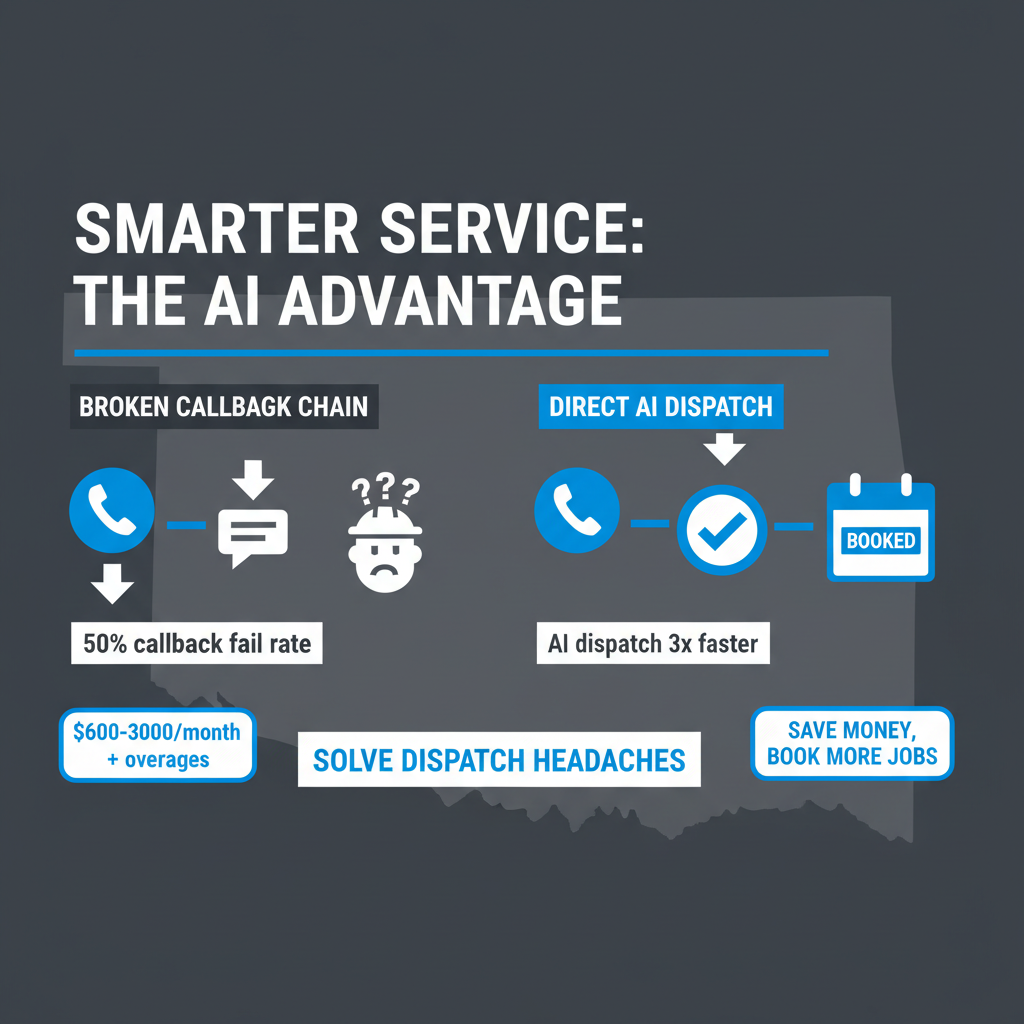
[Direct Answer] Answering services miss an average of 50% of callback attempts and cost $600–$3,000/month with unpredictable overages. Oklahoma contractors are abandoning traditional answering services — not for cost, but because AI dispatch systems capture and qualify every call without the callback failure rate or human error that sinks answering service operations. Steel Blueprint's Virtual Front Desk handles every inbound contact, routes it directly to the schedule, and keeps the business owner in total control of the qualification logic.
Introduction
It's 2:45 PM on a Tuesday. An Oklahoma plumber is halfway through a 90-minute job. His phone rings — a new potential customer from a Google search for "emergency plumber near me." The answering service picks it up, takes a message. Says they'll pass it along. Says the plumber will call back within 30 minutes.
The plumber calls back at 4:15. Voicemail. The customer has already called two other plumbers. Both answered. Both are already on the schedule.
This is not an outlier. This is the current state of the answering service industry — a bottleneck between leads that arrive hot and contractors who never get a clean callback attempt.
The answering services that dominated Oklahoma's contractor market for two decades are losing market share, not to price cuts, but to a structural problem they can't solve: the human callback loop is broken.
The Answering Service Callback Problem Nobody Talks About
Every time an answering service takes a message, they create a dependency: the contractor must call back. If the contractor doesn't call back within a specific window, the lead cools. If they call back and the customer doesn't answer, they've lost the job — and the answering service just charges them another month's bill as if nothing happened.
Bland.ai's research on contractor answering services found that approximately 50% of callback attempts from contractors never reach the customer who originally called. Not because the contractor is slow — but because callback timing is fragile. A customer who calls at 3 PM is not reliably available at 4:15 when the contractor finally finishes and calls back.
Meanwhile, 85% of callers who reach voicemail never leave a message — meaning the answering service never captures them at all.
The math looks like this for an Oklahoma HVAC shop:
- 200 calls per month (peak season)
- 40% miss rate on initial answer (contractors on jobs) = 80 unanswered
- Answering service catches 70 of them
- 50% callback success rate = 35 jobs actually booked from 200 calls
- ROI on answering service: $1,200/month service fee ÷ 35 jobs = $34 cost per captured job
- Compare to: 1 missed call = $350+ lost revenue
The answering service is working. But half the callbacks are failing. And Oklahoma contractors are recognizing the gap.
Why Answering Services Can't Compete With Real-Time Dispatch
Answering services were built on a 1990s model: take a message, store it, hope the contractor calls back in time. That model assumes:
- Customers are patient (they're not)
- Contractors can call back immediately (they can't — they're on jobs)
- The customer will be available when the contractor finally calls back (they won't)
Modern AI dispatch systems flip the model entirely. Instead of "contractor calls customer back," the system says: "I'll take the job details right now and route it to the schedule immediately."
Why? Because the qualification and scheduling happen in real time — not in a delayed callback loop.
For an Oklahoma HVAC owner, the difference is concrete:
- Answering service: Customer calls → service takes message → owner calls back → customer doesn't answer → job lost
- AI dispatch: Customer calls → system qualifies the call → job automatically routed to available tech → confirmation text sent to customer within 90 seconds
One model loses the callback. The other never loses the job.
The Quality Problem Contractors Don't See Until They're Too Late
Answering services advertise 24/7 coverage and professional service. What they don't advertise is what happens when:
- A message gets lost in the handoff between shifts
- A receptionist misunderstands a customer's address or emergency level
- A job gets written as "plumbing leak" when it's actually a sewage line (different price point, different crew qualification)
- Peak season hits and the service is understaffed, so callback quality drops
Oklahoma contractors working with traditional answering services report these issues consistently:
- Message accuracy: Nearly 40% of contractors say answering services misrecord critical details (address, phone number, job type) that require follow-up calls from the contractor
- Callback speed: Average callback time is 15–45 minutes after the contractor returns from a job and checks messages — by which point 50% of leads have already called competitors
- No qualification: A generic "call the customer back" message doesn't tell the contractor anything about job urgency, customer budget, or service area — leading to wasted callback time on jobs outside the service radius
This is where AI dispatch systems built for trades win the competitive advantage. They're designed by people who understand HVAC emergency calls are different from plumbing calls, which are different from roofing jobs. Field-aware systems qualify by job type, route by availability and skill set, and confirm appointments before the contractor even finishes the current job.
What Oklahoma Contractors Are Switching To
The contractors leaving answering services aren't going to a different answering service. They're switching to Virtual Front Desk systems — owner-controlled AI dispatch infrastructure that sits between the phone and the schedule.
The founder of Steel Blueprint came from a Fortune 50 company where he ran AI systems for a $34 billion portfolio. He also spent years working in the field — laying sod, building barns, managing crews in Oklahoma summers. When he built the Steel Blueprint Virtual Front Desk, it wasn't designed to replace the owner's judgment. It was designed to replace the administrative gap that answering services never solved: the callback bottleneck.
Here's what changes:
Before answering service: Customer calls 3 PM → message taken → contractor calls back 4:15 → customer busy → job lost
After Virtual Front Desk: Customer calls 3 PM → system qualifies (emergency? location? price range?) → job routes to tech with capacity → text confirmation sent 90 seconds later → customer booked
The Virtual Front Desk handles every call, chat, and text automatically. The owner defines the qualification rules, service area, and dispatch logic. Nothing replaces the owner's skill or judgment — it just replaces the administrative layer that used to drop calls in the callback gap.
For Oklahoma contractors specifically, this matters because:
-
Emergency response matters more. HVAC failures at 8 PM, roof leaks during storms, burst pipes in winter — these calls have real time sensitivity. A callback loop loses them. Real-time dispatch captures them.
-
Local accountability matters more. A national answering service in a call center two states away doesn't understand Oklahoma weather patterns, service areas, or the trades culture. A Virtual Front Desk built by a Piedmont HS graduate who serves on the Yukon Chamber of Commerce board and co-owns Red Dirt Apparel understands the community from lived experience.
-
Crew continuity matters more. When a dispatcher quits (23% annual turnover in call centers), the answering service finds a replacement. When your Virtual Front Desk loses a team member, it doesn't — because the system doesn't depend on human memory. The rules and workflows stay the same.
The Local Advantage — Why Oklahoma Contractors Trust This More Than a National Service
A large answering service in Tampa or Denver works the same way for plumbers, HVAC contractors, electricians, and roofers. They use the same script. The same qualification logic. The same callback process.
Steel Blueprint's Virtual Front Desk is different because it's built by someone who's actually worked in the field, understands Oklahoma's market, and is accountable to the community.
The founder graduated from Piedmont High School in 2010. He's on the board of Hoof and Hero Sanctuary. He's active in Yukon Chamber of Commerce. His wife Taryn owns Red Dirt Apparel and is part of the Oklahoma business community. When a contractor's system breaks, they don't call a help desk in another state. They call someone who's invested in seeing Oklahoma trades businesses win.
That's not just marketing framing — it's how accountability actually works in a small market. A national answering service can hide behind corporate policy. A local operator has their reputation on the line every day.
What the Numbers Show About Answering Service Market Shift
The data on answering service effectiveness has been moving for three years:
- 50% callback failure rate on answering service messages — customers don't answer on callback, job is lost
- 85% of voicemail callers never leave a message — answering services never capture them
- $600–$3,000 per month baseline cost, plus per-minute overages during peak season
- 70–85% of contractors now say they'd switch to an AI dispatch system if they could control it themselves
- Field service companies using AI dispatch see 20–30% higher close rates and 3x faster job completion time vs. contractors relying on answering services
The pattern is clear: answering services worked when contractors had no alternative. Now that alternatives exist, the callback failure rate is becoming a competitive disadvantage.
How to Stop the Callback Bleed
If you're currently using an answering service and losing jobs to callback delays, the fix is straightforward: replace the callback bottleneck with real-time dispatch.
That means:
1. Every call is answered immediately — no queue, no delay, no risk of the caller hanging up after 2–3 rings
2. Qualification happens in real time — the system asks the right questions (emergency level, location, job type) so the contractor knows exactly what they're calling back about
3. Appointment confirmation happens automatically — the customer gets a text confirmation within 90 seconds, not a "contractor will call back" message
4. The owner stays in total control — you define the service area, the qualification criteria, the dispatch rules, the pricing logic. The system executes your rules, 24/7, without interpretation or error
Five founding partner slots are open in Oklahoma right now. When those slots close, the territory closes. No new partner.
→ Claim Your Partner Slot → See How the Virtual Front Desk Works → See What the Callback Bleed Is Costing You
Frequently Asked Questions
Q: Are you saying answering services are completely dead? A: No. They still work for businesses where callback timing is less critical — legal offices, medical practices, real estate. For trades businesses where emergency calls and peak-season volume spike unpredictably, the callback bottleneck is now a competitive disadvantage. Oklahoma contractors are recognizing this and switching.
Q: If I switch to AI dispatch, do I lose the human touch? A: You gain it. A Virtual Front Desk answers 100% of calls professionally within the first ring. A human answering service answers maybe 70% on the first ring (while techs are on jobs). The "human touch" is taking the message correctly and getting it to the contractor in time. AI dispatch does both better.
Q: Can I try this without committing to a full partner slot? A: Yes. Every partner slot includes a demo where you see exactly how the system handles your incoming calls — how many it answers, how fast it qualifies them, how many get booked automatically. You'll see the callback difference immediately.
Q: What happens if I want to change the rules (service area, pricing, qualification logic)? A: You change them yourself. The Virtual Front Desk is owner-controlled, not vendor-controlled. No waiting for IT support in another state. You're in command.
Q: Is this just an "AI chatbot"? A: No. It's dispatch infrastructure built by someone who actually understands how Oklahoma trades operate. It's not designed to replace your crew or your judgment. It's designed to replace the administrative layer — the callback gap — that answering services were never designed to solve.
Sources
- Bland.ai — 11 Best Answering Services for Contractors
- AgentZap — HVAC Industry Phone Statistics
- MyQuoteIQ — Top 10 CRMs With Built-In Answering Service for Contractors (2026)
- Bridgital — How to Stop Losing Revenue to Missed Calls
- SkipCalls — Why After-Hours Missed Calls Cost Contractors
- FusionCX — Contractor Phone Answering Service to Stop Losing Jobs
- PlumblineAnswers — 5 Ways Contractor Answering Service Prevents Missed Calls
- PatLive — Benefits of an Answering Service for Contractors
- AnswerConnect — Oklahoma Answering Service
- Steel Blueprint — Cost of Inaction