[Direct Answer]
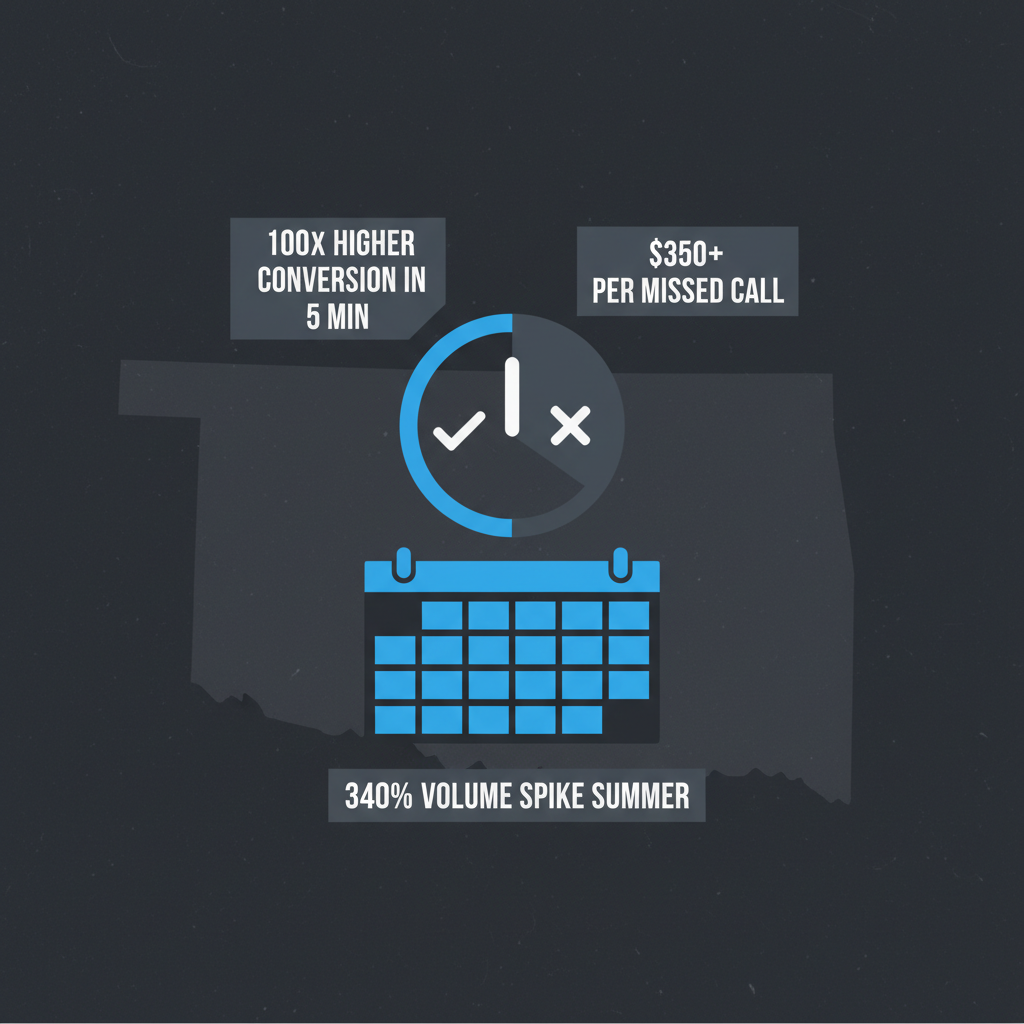
An Oklahoma HVAC owner who doesn't answer [call today costs $350 minimum in lost revenue, but the real damage comes from crew schedule gaps and compounding callbacks](https://agentzap.ai/blog/hvac-phone-statistics). [Response time in the first 5 minutes converts leads at 100x higher rates than 30-minute delays](https://voiso.com/articles/lead-response-time-metrics/) — meaning every dark call isn't just one lost job, it's a cascade of operational problems: crews sitting idle, callback trips, emergency work backing up, and customers moving to competitors who answered first. Steel Blueprint's Virtual Front Desk ensures zero dark calls, 24/7, while the owner stays in complete control of who takes what, when, and how much it's worth.
---
Introduction
It's 97 degrees outside. 2 PM on a Tuesday in July in Oklahoma City.
An HVAC owner has two crews in the field, one heading back to the shop in 45 minutes, and a third crew already booked for emergency callbacks this evening.
His phone rings. He doesn't see it until 2:47 PM.
It's a homeowner with a dead compressor and a $4,200 emergency service window. But by 2:47, the homeowner has already called two other contractors and gotten a same-day confirmation from one of them. The call was won in the first 5 minutes — and the first 5 minutes had no one picking up.
That wasn't just one lost job. That was a missed scheduling opportunity that now forces the third crew to wait for callbacks instead of service the afternoon call that would have been on the books.
This happens 8–12 times a week in a typical Oklahoma shop.
And it's not a lead generation problem. It's an operational problem.
---
What "Response Time" Actually Costs an HVAC Operation
The standard stat is easy: [each missed call costs an HVAC contractor $350 or more](https://agentzap.ai/blog/hvac-phone-statistics). That's real money. But what most owners don't calculate is the hidden cost that compounds across a full day's operations.
When a call goes unanswered:
- Immediate loss: That job is gone. $350–$1,500 depending on service type
- Crew gap created: The callback crew now has 90 minutes of idle capacity that can't be backfilled with a same-day appointment
- Efficiency drop: Callbacks scheduled later take longer because equipment has already failed, creating longer-than-normal diagnostics
- Customer lifetime loss: That homeowner who called and didn't reach you? [85% of callers who reach voicemail won't leave a message](https://agentzap.ai/blog/hvac-phone-statistics). They're gone permanently.
Stack that across a summer week, and [HVAC call volume spikes up to 340% higher in summer vs spring](https://agentzap.ai/blog/hvac-phone-statistics) — meaning more calls are coming in, and missing even a few creates exponential scheduling breakdown.
[The research is definitive: responding to a lead within 5 minutes increases conversion at rates 100x higher than a 30-minute response](https://voiso.com/articles/lead-response-time-metrics/). In field math: 5 minutes = booked job. 30 minutes = customer already scheduled someone else. There's no recovery after that.
---
Why Crews Can't Answer Phones — And Why That's the Real Problem
Here's the operational reality that generic answering services don't understand:
Your HVAC technicians can't answer phones. They're in crawlspaces. On roofs. In attics where the thermostat is reading 130 degrees. Stopping a service call to answer the phone isn't just inconvenient — it's a safety hazard, a job quality problem, and a customer experience disaster.
But here's what generic answering services miss: your crew *also* can't make decisions about what gets booked when. They don't know if the next call is an emergency requiring immediate dispatch, a maintenance agreement renewal that should be scheduled 4 weeks out, or a service call the homeowner can't afford right now.
A generic answering service uses a script: "Can I get your name and number?" They capture the call. But they don't understand HVAC workflow.
A field-aware system understands:
- Emergency (compressor failure, no cooling, safety hazard) vs non-emergency (maintenance tune-up, filter replacement)
- Customer history (maintenance member vs first-time caller)
- Crew availability and skill match (commercial vs residential, new install vs service call)
- Pricing tiers (premium emergency vs standard appointment)
[47% of after-hours HVAC emergency calls never reach a human](https://www.linkedin.com/posts/newo-ai_hvac-activity-7454918728908972032-ig1e) — they go straight to voicemail because the business has no infrastructure to handle after-hours volume. The homeowner assumes the company doesn't answer after 6 PM and moves on.
That's the operational gap. Not that calls are missed. But that *qualified* calls are missed.
---
The 24-Hour Operational Math — Why One Dark Shift Breaks Your Week
Let's run the real numbers for a 3-crew Oklahoma HVAC operation.
Baseline summer revenue per day: $4,200 (3 crews × $1,400 average daily billing)
Peak call volume (summer): 15–20 inbound calls per day across all channels (phone, website, referrals)
Missed call rate (no answering infrastructure): 25–35% during business hours; 100% after 6 PM and weekends
Cost per missed call: $350–$1,500 (depends on call type)
What happens in one week with dark call intake:
| | With Answer System | No Answer System |
|---|---|---|
| Inbound calls captured | 100 calls/week | 65 calls/week (35% lost to voicemail) |
| Booked appointments | 65 jobs (65% conversion) | 30 jobs (35% conversion after callbacks) |
| Revenue captured | $4,550 per week | $2,100 per week |
| Weekly impact | — | -$2,450 lost |
| Annual impact | — | -$127,400 unrealized |
But the real cost is worse. Because missed calls also create crew inefficiency. When jobs aren't captured in real time, callbacks are scheduled 2–3 days later. Rush appointments cost more, customers are already frustrated, and crew utilization drops.
Add scheduling chaos to missed revenue, and the actual impact is closer to -$180K+ annually for a 3-crew shop that lets calls go dark.
---
What Owner-Controlled Response Infrastructure Actually Looks Like
The critical difference between "answering service" and "dispatch infrastructure" is control.
A generic answering service: You pay $600–$1,500/month, they answer the phone according to their script, they take a message, they call you back hours later, you have no visibility into what was said or how it was qualified.
An owner-controlled system: Every call is answered. The owner defines what "answer" means. Emergency calls get routed to the on-call crew immediately. Maintenance calls get scheduled with the next available appointment. Customers who aren't ready to book right now get added to a follow-up sequence. The owner sees every call, every interaction, complete control.
For an Oklahoma HVAC owner specifically, that means:
- After-hours calls are answered instantly — not routed to voicemail, not calling back tomorrow, answered NOW with qualified intake
- Emergency qualification happens in real-time — the system knows if this is a compressor failure (dispatch immediately) vs a thermostat question (schedule appointment)
- Crew scheduling is automated — available tech gets the call, not "call us back and we'll figure out scheduling"
- Customer history is available — if they're a maintenance member, they're quoted maintenance pricing; if it's their first call, they get the full intake flow
- No human middleman cost — no $1,200/month answering service fee, no message delays, no "I called this company 3 times and never heard back"
That's the difference between a tool that answers phones and infrastructure that runs your front desk.
---
The Local Advantage: Why an Oklahoma Owner-Controlled System Beats National Chains
Steel Blueprint is built by someone who understands what an Oklahoma HVAC operation actually looks like. The founder graduated from Piedmont High School in 2010. He's built metal frame barns with his hands. He's felt the pressure of a service truck idling in an Oklahoma summer heatwave.
He's also built AI systems for a $34 billion global portfolio at a Fortune 50 company.
That's the combination: enterprise systems architecture + field-tested trades experience + Oklahoma accountability.
A national answering service sees "HVAC company in Oklahoma City" and sends your call to a call center in Kansas City reading a script. A national SaaS platform sees "contractor" and builds generic features that work for everyone and work for no one.
Steel Blueprint sees an owner who's great in the field, great with a crew, good at the work — but losing jobs because the front desk can't hold the line at 6 PM.
The founder serves on the board of the Hoof and Hero Sanctuary. He's active in the Yukon Chamber of Commerce. His wife Taryn owns Red Dirt Apparel. They're not vendors. They're neighbors. And when an Oklahoma HVAC owner has a problem with the system, he can text the guy who built it.
That accountability is worth more than any national support line.
---
What the Numbers Show About Response-Time-Driven Growth
The research on response time is settled. [Responding within 5 minutes increases conversion at rates 100x higher than 30-minute delays](https://voiso.com/articles/lead-response-time-metrics/). [Within 1 minute, conversion jumps to 391% higher than 30-minute responses](https://www.demandlocal.com/blog/crm-lead-response-time-impact-statistics/). That's not a marginal improvement. That's structural.
For HVAC specifically:
- [85% of voicemail callers won't leave a message](https://agentzap.ai/blog/hvac-phone-statistics) — they call someone who answers
- [Call volume in summer peaks 340% higher than spring](https://agentzap.ai/blog/hvac-phone-statistics) — peak season is when response time matters most
- [47% of after-hours emergency calls go unanswered nationally](https://www.linkedin.com/posts/newo-ai_hvac-activity-7454918728908972032-ig1e) — Oklahoma contractors are missing 5–7 emergency calls per week on average
- Each emergency call represents $1,200–$2,500 in revenue capture opportunity
Stack those numbers: an Oklahoma HVAC shop with 3 crews missing just 2 emergency calls per week is leaving $120K–$250K on the table annually.
---
How to Lock In 24/7 Response Without Hiring a Night Dispatcher
The traditional answer was always: hire an office person. Pay $35–$45K/year for someone to answer phones, take calls, manage callbacks. But that person takes vacation. Gets sick. Needs a raise. Leaves the company. And you're back to scrambling.
The modern answer: operational infrastructure that runs 24/7 and gets smarter the more calls it processes.
A Virtual Front Desk handles every call the way the owner would handle it — because the owner sets the rules. Emergency calls go to the on-call tech. Appointments get booked directly into the schedule. Maintenance members get queued for renewal outreach. Quotes get sent automatically. Follow-ups happen without anyone's manual effort.
The owner doesn't have to be on the phone. But every call gets answered like the owner is on the phone.
That's why it's not "automation" in the scary sense (replacing people). It's infrastructure in the operational sense (freeing your crew from admin and letting them focus on the work).
Five founding partner slots are open in Oklahoma right now. When they close, the territory closes. No new Virtual Front Desk partners in that region.
→ [Claim Your Partner Slot](https://steelblueprint.com/#section-8vcvgV5Syg)
→ [See How the Front Desk Handles a Typical Day](https://steelblueprint.com/#section-a-CUL_UidX)
→ [Calculate What One Dark Night Shift Costs You](https://steelblueprint.com/#section-wuh6bMf_5y)
---
Frequently Asked Questions
Q: If I set up a Virtual Front Desk, do I lose control of what gets booked?
A: No. The opposite. You define every parameter: service area, pricing tiers, emergency criteria, which calls route to which crew, which calls get callbacks vs immediate scheduling. You stay in total command. The system executes your rules 24/7.
Q: What happens to calls during peak summer when call volume triples?
A: The system handles it. No dropped calls, no queue delays, no "press 1 to wait on hold." Every call is answered in seconds, qualified appropriately, and routed. Peak volume is exactly when you want this infrastructure most.
Q: How is this different from an answering service?
A: An answering service takes a message. A Virtual Front Desk answers the phone the way you would, qualifies the call, books appointments directly into your system, and sends you summaries. No middleman, no message delay, no script.
Q: Do my crews see the calls, or just the owner?
A: You decide. Emergency calls can route directly to the on-call crew with full context. Non-emergency calls can be managed through a central queue. Full visibility for whoever needs it, zero distraction for crews in the field.
Q: What if a customer needs something the system can't handle?
A: That doesn't happen often, but when it does, the call routes to a human — the owner, the office manager, or whoever's on duty. The system filters the routine calls so humans only handle the truly complex ones.
Q: How much does this cost vs. an answering service?
A: Answering services run $600–$3,000/month plus overages. A Virtual Front Desk is priced on the actual complexity of your operation and integrates directly with your existing tools. The math usually comes out cheaper and generates way more revenue because calls actually turn into booked jobs.
Q: Is this available in my area right now?
A: Steel Blueprint is Oklahoma-focused with 5 founding partner slots per territory. Text "AUDIT" to 405-335-4533 to check availability in your specific area and get a free Missed-Call Revenue Audit showing exactly what dark calls are costing you.
---
Conclusion
An Oklahoma HVAC owner can't afford to let calls go dark. Not in summer. Not ever.
Every unanswered phone is crew downtime. Every crew downtime is lost scheduling optimization. Every lost scheduling opportunity is revenue that won't come back — and customers who won't call you again because you didn't answer the first time.
Response time in the first 5 minutes determines who wins the job. Infrastructure that holds that 5-minute window 24/7 — without hiring anyone, without voicemail, without middlemen — is the difference between a shop that's good at the work and a shop that's good at the work *and* capturing all the work that's available.
Steel Blueprint's Virtual Front Desk is built for exactly this. Owner-controlled. Field-aware. Oklahoma-rooted. Ready for whatever call volume summer throws at you.
→ [Schedule Your Demo](https://steelblueprint.com/#section-8vcvgV5Syg)
→ [See Your Missed-Call Cost](https://steelblueprint.com/#section-wuh6bMf_5y)
---
Sources
1. [AgentZap — HVAC Industry Phone Statistics: 15 Numbers Every HVAC Owner Should Know](https://agentzap.ai/blog/hvac-phone-statistics)
2. [VOISO — How Faster Lead Response Times Can Skyrocket Conversion Rates](https://voiso.com/articles/lead-response-time-metrics/)
3. [The KeyBot — How Much a Missed Call Really Costs (2026 Research)](https://www.thekeybot.com/research/missed-call-cost-2026)
4. [PCN Answers — 2026 Small Business Missed Call Revenue Study](https://pcnanswers.com/missed-call-revenue-study/)
5. [Demand Local — 43 CRM Lead Response Time Impact Statistics](https://www.demandlocal.com/blog/crm-lead-response-time-impact-statistics/)
6. [HVAC Marketing Xperts — Why Most HVAC Leads Never Turn Into Paying Customers](https://hvacmarketingxperts.com/why-most-hvac-leads-never-turn-into-paying-customers-and-how-to-fix-it/)
7. [Powerchord — Why HVAC Companies Lose Leads in the First Five Minutes](https://www.powerchord.com/blog/hvac-speed-to-lead)
8. [VIDA.io — HVAC Lead Generation: Complete Guide](https://www.vida.io/blog/lead-generation-hvac)
9. [LinkedIn — HVAC Emergency Calls: The 47% That Never Reach a Human](https://www.linkedin.com/posts/newo-ai_hvac-activity-7454918728908972032-ig1e)
10. [Steel Blueprint — Cost of Inaction](https://steelblueprint.com/#section-wuh6bMf_5y)