
The Everyday Entrepreneur
Why Oklahoma Contractors Are Leaving Generic Answering Services — And What's Replacing Them
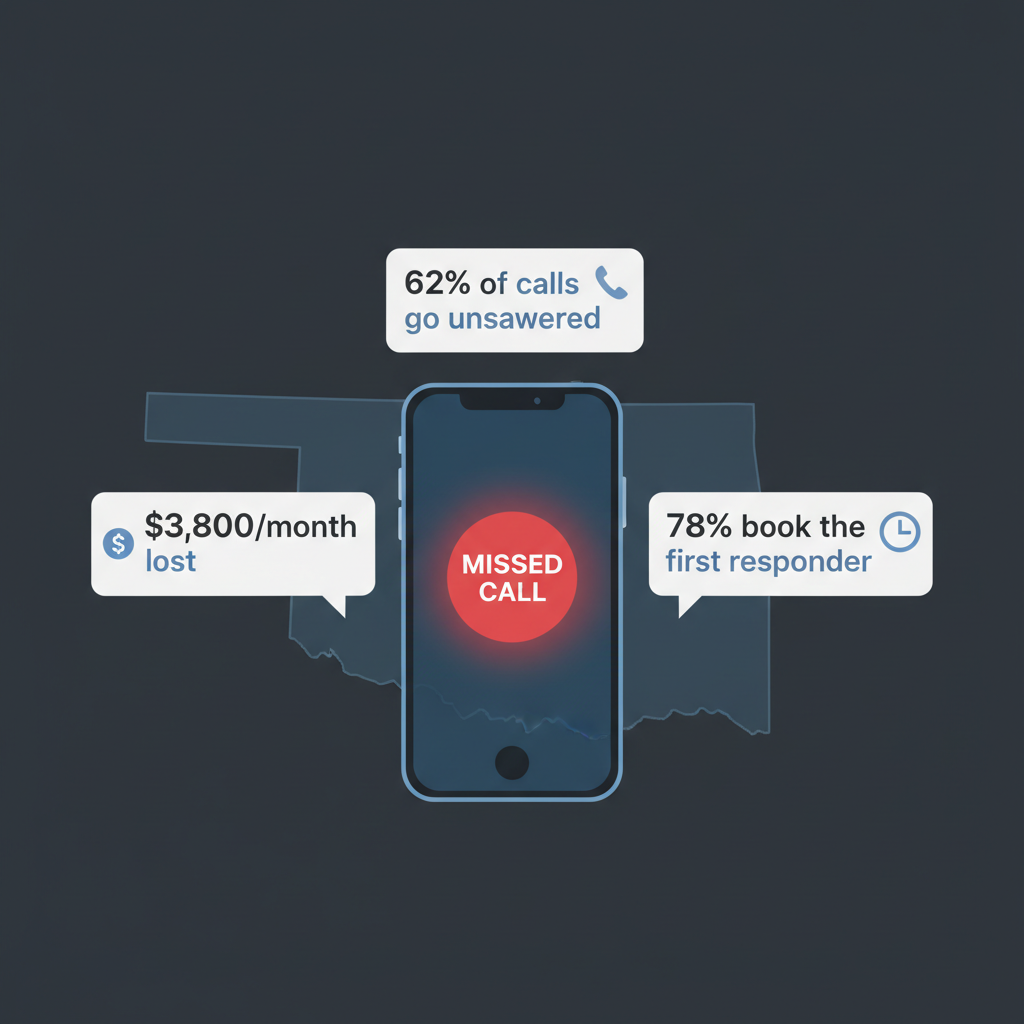
[Direct Answer] Oklahoma contractors are leaving traditional answering services because generic call centers don't understand field workflows, miss critical details, and cost between $135–$450 per month without improving conversion. Each missed call costs HVAC contractors an average of $350 or more, and 78% of trade contractors have already adopted or are testing AI tools designed specifically for field service businesses. Steel Blueprint's Virtual Front Desk is replacing traditional answering services by handling the full intake, qualification, and booking layer — keeping the owner in complete control without call center delays or generic scripts.
Introduction
It's Thursday evening in Oklahoma City. Your HVAC crew is wrapping up a tough day. You're running behind on calls, and the phone is ringing.
You don't see it. Your answering service picks it up instead.
The call is from a homeowner with a no-cool situation — a $1,200 potential service call. But the answering service agent doesn't know your service area, doesn't know your pricing, and puts the customer on a generic voicemail callback list instead of adding them to your schedule.
By the time they call you back the next morning, the homeowner has already called the contractor who answered first — the one who got their number. That's your job. That's your margin. That's money that walked because the answering service couldn't close the gap between lead arrival and first response.
This is why Oklahoma contractors are walking away from traditional answering services and building owner-controlled infrastructure instead.
What Generic Answering Services Actually Cost — Beyond the Monthly Bill
The sticker price looks reasonable. $135 to $450 per month, depending on volume. Most answering services charge by the minute or offer bundled call packages.
The real cost is the jobs you lose.
Each missed call or mishandled call costs HVAC contractors an average of $350 in immediate lost revenue — and the true cost is significantly higher when you factor in the labor spent calling back, the customer frustration, and the repeat business that doesn't happen. For a plumbing or electrical contractor in a seasonal market, one missed winter storm call during a freeze can represent $1,200 to $3,000 of lost work.
The problem isn't the answering service price itself. The problem is what answering services actually do:
- They take a message. They don't close the sale. They don't book the appointment. They don't qualify the lead. They answer the phone and take information — and then you have to follow up.
- They don't understand your workflow. A generic answering service agent doesn't know the difference between a routine maintenance call and an emergency system failure. They don't know your service area, your parts inventory, or which dispatcher needs to know about this job right now. They're reading a script.
- They create a delay. Every hour between the customer's call and their callback is another opportunity for that homeowner to call a competitor. And in the trades, response time is the difference between a booked job and a lost job.
Studies show that 80% of leads are lost if not responded to within 5 minutes of first contact. An answering service doesn't close that 5-minute window. It widens it.
Why Oklahoma Contractors Are Fed Up With Generic Call Centers
The fundamental problem with traditional answering services is structural: they're built for volume, not for field service.
A call center agent in a different state doesn't know your Oklahoma market. They don't know whether a customer calling at 7 PM needs emergency dispatch or can wait until morning. They don't know your pricing, your integration with ServiceTitan or Jobber, or which crew member should get the work. They're trained to be polite, take information, and hand it off.
That hand-off is the breakdown point.
For Oklahoma contractors specifically, this gap costs even more because:
Seasonal demand spikes are unforgiving. When a summer heat wave hits or an Oklahoma winter freeze forces emergency calls, the contractor who answers first and books the job wins. The one whose answering service says "someone will call you back" loses.
Service areas are geographically large. Contractors serving Oklahoma City, Tulsa, or surrounding rural counties can't afford delayed dispatch. A 30-minute callback from the answering service means the crew has already moved on, and the customer has found someone else.
Margins are tight and visible. 78% of trade contractors are already using or testing AI tools because they've realized that technology directly impacts labor costs, dispatch efficiency, and profitability. Contractors aren't adopting AI because it's trendy. They're adopting it because it makes them money. A $250/month answering service that costs you one $1,200 job a week is actually costing you $50,000 per year.
That math doesn't work anymore.
What's Actually Replacing Answering Services — And Why It's Not Just a Better Script
The contractors winning in Oklahoma aren't replacing answering services with another answering service. They're replacing them with owner-controlled infrastructure that functions entirely differently.
A Virtual Front Desk isn't a call center. It's a system designed to handle the full lead intake, qualification, and scheduling layer — operating 24/7 according to the owner's rules, not a call center script.
Here's the functional difference:
Answering Service Workflow: 1. Customer calls 2. Agent answers with generic greeting 3. Agent takes message 4. Agent leaves voicemail for contractor 5. Contractor calls back (too late, customer moved on)
Virtual Front Desk Workflow: 1. Customer calls 2. System answers in seconds 3. System qualifies the call (emergency vs routine, service area match, price tier) 4. System books the appointment directly into your schedule 5. Customer is booked, confirmation sent automatically
With a Virtual Front Desk, the customer doesn't wait for a callback. The job is in your schedule. The crew sees it. The contractor controls every part of the process.
The Local Advantage — Why an Oklahoma Company Built This Differently Than National Answering Services
The founder of Steel Blueprint graduated from Piedmont High School in Oklahoma in 2010. Since then, he's done something no national answering service CEO has done: he's actually worked a field crew. He's built metal frame barns with his own hands. He's felt the pressure of a service truck idling in an Oklahoma summer heat wave.
Then he spent a decade building enterprise-grade AI systems for a $34 billion global portfolio at a Fortune 50 company.
That combination — field credibility plus enterprise systems architecture — is why Steel Blueprint built a Virtual Front Desk from the ground up for trades owners, not adapted one from a generic call center template.
The company is headquartered in Oklahoma, not Florida or California. The founder serves on the board of the Hoof and Hero Sanctuary, is active in the Yukon Chamber of Commerce, and his wife Taryn owns Red Dirt Apparel. When something breaks with your Virtual Front Desk at 10 PM, you're not calling a help desk in a different time zone. You're calling the person who built it — the person whose name is on the line in this community.
That's not a competitive advantage a national answering service can replicate. It's built on accountability.
What the Numbers Show — Why Contractors Are Making This Switch Now
The momentum is real. Here's what the data says:
AI Adoption in Trades is Already Mainstream. 78% of commercial contractors have adopted AI workflows or are actively testing them. This isn't a future trend. This is what winning contractors are doing right now.
The Cost of Missed Calls Has Never Been Higher. Each missed call or mishandled lead costs HVAC contractors an average of $350 or more. For a busy week in Oklahoma, that's $1,400 to $3,500 per week in lost revenue. Over a year, one missed call per day averages over $90,000 in lost capacity.
Traditional Answering Services Are Static. An answering service typically costs $135–$450 per month, but that cost doesn't improve conversion, doesn't integrate with your dispatcher, and doesn't understand your business. You're paying for phones to be answered, not for jobs to be booked.
Speed-to-Lead Is the Real Difference Maker. Leads contacted within 5 minutes convert at significantly higher rates than leads contacted 30 minutes later. The difference between a 5-minute response and a 30-minute callback is the difference between a booked job and a customer who found someone else.
For Oklahoma contractors, the decision is simple: pay for phones to be answered, or pay for a system that actually closes the sale.
How to Stop Paying for Call Center Scripts — And Start Owning Your Own Lead Intake
The first step is recognizing that a better answering service isn't the answer. You need different infrastructure entirely.
A Virtual Front Desk works because it operates under your rules, not a call center's script. You define:
- What calls are emergency vs routine
- Which service area you're covering
- What questions get asked before the appointment is booked
- Whether a lead gets routed to your schedule immediately or sent to a follow-up queue
- How confirmation messages are worded and when they're sent
The owner stays in complete command. The system executes that command 24/7 without human intervention, without a third party, without a handoff.
For Oklahoma contractors ready to move beyond answering services, this is the operational refit that actually moves the needle: every call answered, every lead qualified, every job booked — by your rules, in your business, under your control.
Five founding partner slots are open in Oklahoma right now. When those fill, the territory closes. No new partner in that region.
→ Claim Your Partner Slot → See How the Virtual Front Desk Works → See What Missing Calls Are Costing You
FAQ
Q: What's the difference between an answering service and a Virtual Front Desk? A: An answering service takes a message. A Virtual Front Desk books the job. Answering services hand off to the contractor for callback; a Virtual Front Desk puts the appointment directly in your schedule, ready for dispatch. One serves as a message relay. The other solves the conversion problem.
Q: How much does an answering service actually cost? A: The advertised cost is $135–$450 per month. The real cost is what you lose in unbooked jobs. Each missed call or mishandled lead costs contractors $350 on average. If an answering service mishandles one call per week, you're looking at $18,000 per year in lost revenue — not counting the failed followup.
Q: Why would I switch from my answering service to AI? A: Because 78% of contractors who've tested AI workflows are keeping them. Contractors aren't switching because AI is trendy. They're switching because it books more jobs, costs less, and works 24/7 without human fallibility. An answering service asks for information. AI books the appointment.
Q: Is a Virtual Front Desk the same as a chatbot? A: No. A chatbot is a script. A Virtual Front Desk is owner-controlled infrastructure. You set the rules, the system executes them. You can change anything at any time. The business owner stays in complete command — it's not a third-party service that owns the relationship with your customers.
Q: What happens if the Virtual Front Desk can't understand a call? A: Calls that don't fit the owner's rules get escalated to the owner or a designated team member immediately. The system doesn't fake understanding. It knows its limits and escalates to a human when needed. The owner decides what that escalation looks like.
Q: Can I still use my current CRM or dispatcher? A: Yes. Steel Blueprint's Virtual Front Desk integrates with ServiceTitan, Jobber, FieldEdge, and other industry-standard platforms. The system is built to sit on top of your existing tools, not replace them.
Sources
- AgentZap — HVAC Industry Phone Statistics: Missed Calls Cost $350+ Per Call
- BuildOps Report: 78% of Trade Contractors Use AI — AI Adoption Surges Among Contractors
- HouseCallPro — How Much Does an Answering Service Cost? 2026 Guide
- PowerChord — Why HVAC Companies Lose Leads in the First Five Minutes
- NextPhone — AI Receptionist vs. Answering Service (2026)
- Result Calls — Why Pay-Per-Call Leads Cost More Than Clicks
- Ruby — Answering Service vs Virtual Receptionist: What's Better?
- Phone2.io — The True Cost of Missed Calls: Why Small Businesses Need Better Solutions
- Nextiva — Answering Service Cost: What You Can Expect to Pay in 2026
- GetNextPhone — AI Receptionist vs. Traditional Answering Service